Durable Objects: Strongly Consistent State at the Edge
10 Apr, 2026
Scaling state in distributed systems is, historically, an exercise in patience and painful tradeoffs. If you've ever tried building a real-time chat or a multiplayer system, you know the drill: race conditions, centralized database latency, and the nightmare of managing distributed locks with Redis.
Recently, while working on projects that required strict session isolation and low latency, I rediscovered the power of Cloudflare Durable Objects (DO). They aren't just another edge storage solution; they provide a strongly-consistent coordination and storage layer that radically simplifies stateful system architecture.
The "Traditional" Concurrency Problem
In a standard serverless architecture (like AWS Lambda or standard Cloudflare Workers), every request is isolated. If two users try to update the same balance or send a message in the same room at the same time, you need an external coordinator. This usually means:
- Opening a connection to a database or Redis.
- Attempting to acquire a lock.
- Reading the state, modifying it, and saving it.
- Releasing the lock.
This is slow, error-prone, and expensive in terms of latency. Durable Objects invert this logic by providing a stateful environment where consistency is handled by the runtime. However, sharding is vital: a single DO instance handles about ~1,000 requests per second for simple operations; massive scale requires distributing the workload across multiple objects.
What Makes Durable Objects Unique?
The magic of DO lies in the combination of three fundamental characteristics:
- Uniqueness and Identity: Each object has a unique ID. Cloudflare guarantees that, worldwide, there is only one single active instance for that ID at any given time.
- Single-threaded Coordination and Output Gates: All requests for a specific ID reach the same instance. The runtime ensures consistency through Output Gates: the client only receives confirmation after the data is physically persisted. This enables the "Easy, Fast, Correct" model. Note that asynchronous operations (like external I/O) allow for interleaving between requests; execution is not strictly serialized if there are async awaits.
- Practical Example: Consider a session with a credit counter. If the logic does "read balance -> call external API -> update balance", two requests may read the same value before the final write happens. The Durable Object is still the right place to coordinate that state, but the order of operations still needs to be designed carefully.
- Private Transactional Storage: Each object possesses its own state storage, which is transactional and strongly consistent. The modern and recommended path for new projects is SQLite-backed storage, enabling complex queries within the object’s scope. Unlike other distributed storages, data is accessed with high locality by the execution instance.
A Note on Durability: State held only in RAM is not durable. Since the runtime can hibernate or eject the instance at any time to optimize resources, any critical state must be explicitly persisted to the object's storage.
System Design in Practice: The Isolated Chat Case
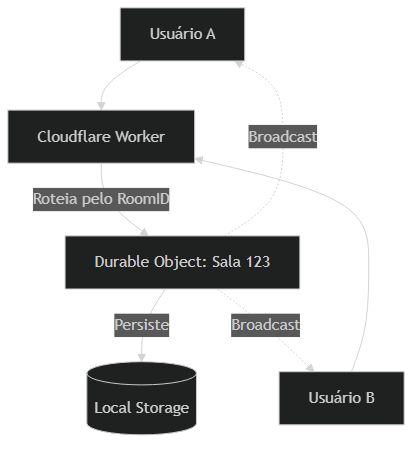
Imagine you're building a chat platform with thousands of independent rooms. In a traditional design, you'd have to handle load balancers, WebSocket sessions spread across multiple servers, and a centralized Pub/Sub to sync everything.
With Durable Objects, the design simplifies to:
- Each Chat Room is a unique Durable Object.
- When a user connects, the Worker routes the request to that room's instance. This instance runs in a single geographic location—typically near the initial access point or according to a localization strategy—enabling local coordination for that entity.
- The DO can keep the user list and volatile state in RAM for performance, while explicitly persisting vital data to local storage to ensure the room can be reconstructed after an eviction or restart.
My Experience: Multi-tenancy and AI Agents
I've used this architecture in two critical projects recently: Robot Orchestration for Credit and the AI Sales Qualification Agent.
In the orchestration project, we needed to ensure strict state isolation between different clients (CORBANs) and their robots. The Durable Object served as the "brain" for each session, ensuring that commands didn't overlap and that the robot's state remained consistent even with network instability.
For the AI Agent, DO was fundamental for managing WhatsApp conversation context atomically. While the AI processes a response, DO ensures that new messages from the same lead don't cause race conditions or duplicate responses, holding the session state extremely efficiently.
When NOT to use Durable Objects
Despite its power, Durable Objects are not a "silver bullet." Avoid using them if you need:
- Global Aggregations: If you need to count something across all objects simultaneously or perform global analytics, a centralized relational or OLAP database is far more efficient.
- Large-scale Search: Storage is private to the object. Searching data across thousands of instances requires a complex external indexing architecture.
- Excessive Coordination: If many objects need to "talk" to each other constantly, network latency between instances can negate performance gains.
The Double-Edged Sword: Trade-offs and Limitations
It's not all magic. By choosing this architecture, you're swapping one type of complexity for another.
- Global Linearizability: Cloudflare guarantees strong consistency within a Durable Object instance. However, if your system depends on a globally linearizable view across all objects (e.g., "exactly how many users are across all 5,000 rooms at millisecond X?"), DO is not the right tool.
- Indexing and Search: Since data is scattered across thousands of edge instances, you lose the ability to perform complex queries or global aggregations that a traditional SQL database would allow. Indexing this data requires a separate strategy (like exporting events to an analytical database or data lake).
- Lack of Centralization: Isolation is your greatest strength and, simultaneously, your biggest headache. If you need frequent coordination between multiple DOs, the design can become complex, and latency might creep back in.
Tips for Getting Started
If you're heading down this path, here are some practical lessons:
- TypeScript by default: The Workers ecosystem is natively TypeScript. Use type definitions for DO bindings to make remote method calls between the Worker and the Object seamless.
- Hono at the Edge: For managing routes and middleware logic, Hono has been one of the most ergonomic and high-performance options in the Workers ecosystem.
- Node Dependency Caution: Remember that you are not in a full Node.js environment. Libraries depending on native Node APIs won't work. Prioritize packages that support Web Standards or are explicitly "Edge-ready."
Conclusion
Cloudflare Durable Objects provide an elegant model for coordination, real-time systems, and multi-tenancy at the Edge. By offering strong consistency where traditional serverless architectures often fail, they have become an essential tool in modern System Design—provided you are mindful of asynchronous concurrency models and persistence strategies.
If you have a problem where state needs strong consistency and a location optimized for its specific point of coordination, perhaps it's time to stop fighting distributed locks and experiment with what the Edge truly has to offer.
Comments